Moving from Stateful to Stateless: Scaling Your Web App with External Session Storage
Unlock horizontal scaling by transitioning from stateful to stateless architecture. Learn how to decouple session data using Redis, NoSQL, or SQL to improve fault tolerance, enable load balancing, and prepare your web app for auto-scaling.
Author
Viruchith Ganesan
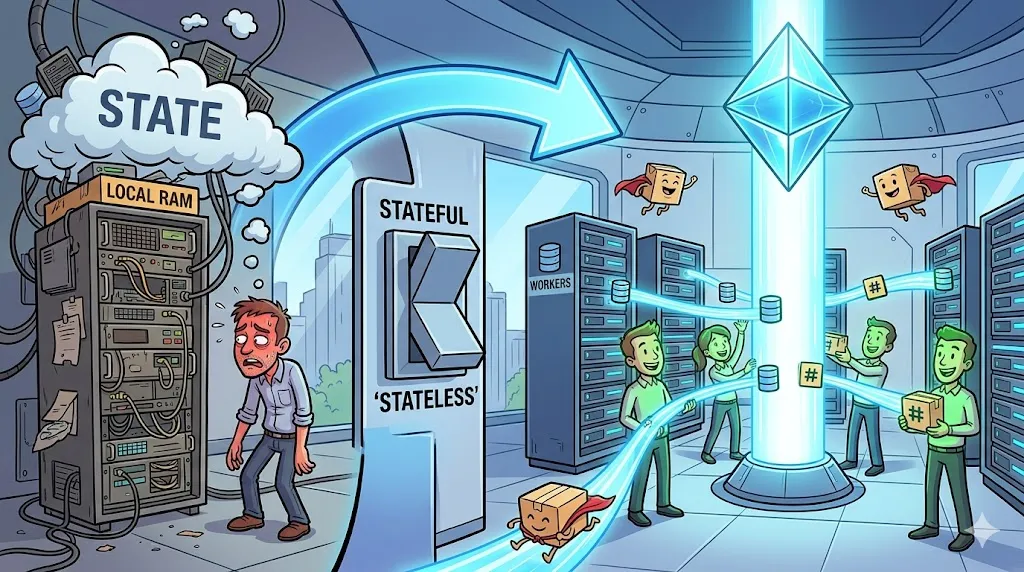
In a traditional web application, sessions are often stored in the local memory (RAM) of the specific server that handled the initial login. While simple to implement, this “stateful” approach creates a major bottleneck: if you add a second server, it won’t recognize a user who logged in on the first one.
To scale horizontally—meaning adding more servers to handle more traffic—you must make your application stateless. This is achieved by moving session data out of the application server and into a centralized data store.
The Architecture: Decoupling State
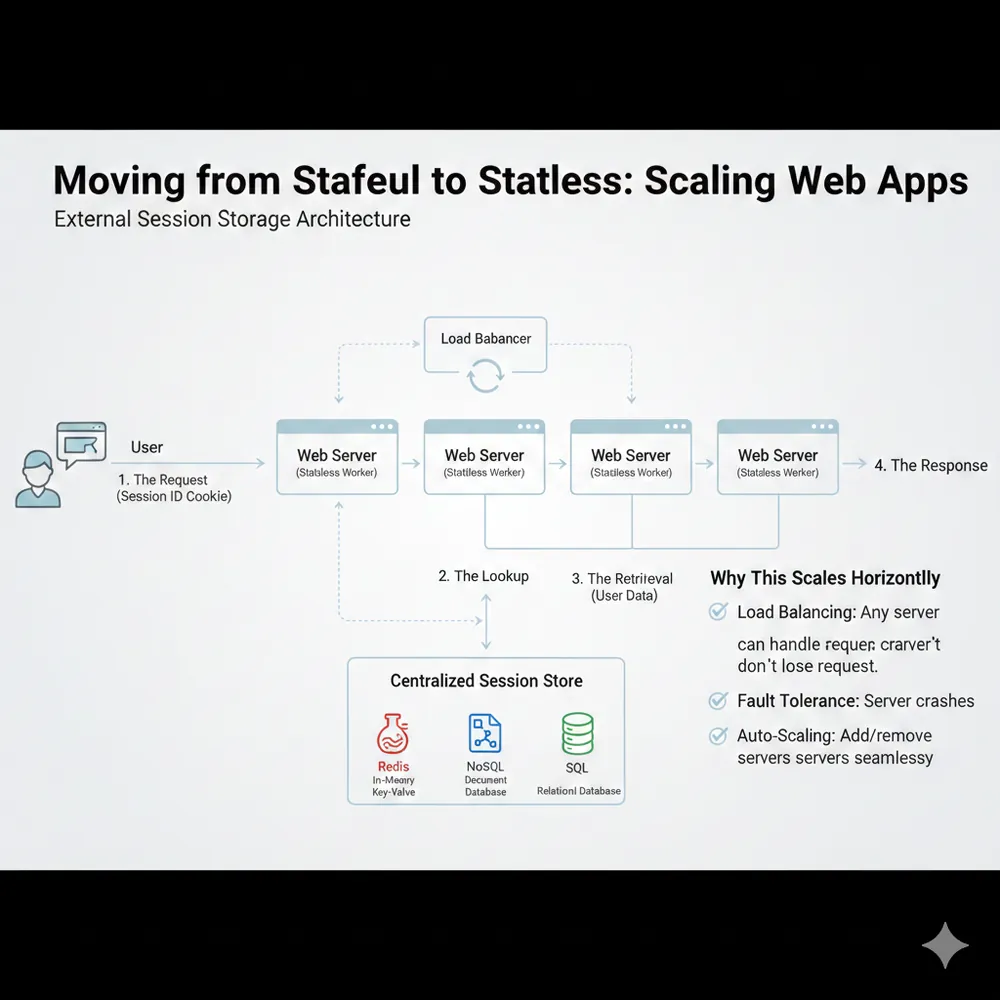
In a stateless architecture, the web server becomes a “disposable” worker. It doesn’t remember who the user is; instead, it fetches that information from a shared database for every request.
- The Request: The user sends a request containing a unique Session ID (usually via a cookie).
- The Lookup: Any available web server receives the request, takes the ID, and queries the Centralized Session Store.
- The Retrieval: The store returns the user’s data (e.g., user ID, permissions, preferences).
- The Response: The server processes the request and sends the response.
Choosing Your Session Store
Since session data is read and written on almost every page load, the storage layer must be incredibly fast. Here are the three common paths:
- Redis (In-Memory Key-Value): The industry standard for sessions. Because it lives in RAM, it offers sub-millisecond latency. It also features “Time-to-Live” (TTL) settings that automatically delete expired sessions.
- NoSQL (e.g., MongoDB, DynamoDB): Excellent for flexible session schemas. If your session objects are large or complex, the document-based nature of NoSQL scales easily and handles high write volumes.
- SQL (e.g., PostgreSQL, MySQL): A solid choice if you want to keep your infrastructure simple and already have a robust database. While slightly slower than Redis, modern SQL databases can handle session loads easily when properly indexed.
Why This Enables Horizontal Scaling
When your servers no longer hold “local” secrets, you gain three critical capabilities:
- Load Balancing: You can use a “Round Robin” approach. A user’s first request can go to Server A, and their second to Server B, without them being logged out.
- Fault Tolerance: If Server A crashes, the user’s session isn’t lost. The load balancer simply directs them to Server B, which pulls the same data from the central store.
- Auto-Scaling: You can spin up ten new servers during a traffic spike and spin them down afterward without interrupting a single user journey.
Implementation Tips
- Keep it Lean: Only store essential data (User ID, Auth status) in the session. Fetch heavier profile data from your primary database.
- Security: Ensure the connection between your web servers and the session store is encrypted and firewalled.
- Serialization: Since you are moving data over a network, ensure your application can quickly convert session objects into a format like JSON or Protobuf.