The "Superchip" Shift: How NVIDIA RTX Spark is Re-Engineering the Modern Laptop
Discover how the new NVIDIA RTX Spark superchip matches up against Apple Silicon. Explore its groundbreaking unified memory architecture, AI performance tiers, and the flagship Windows laptops powered by this next-gen ARM processor.
Author
Viruchith Ganesan
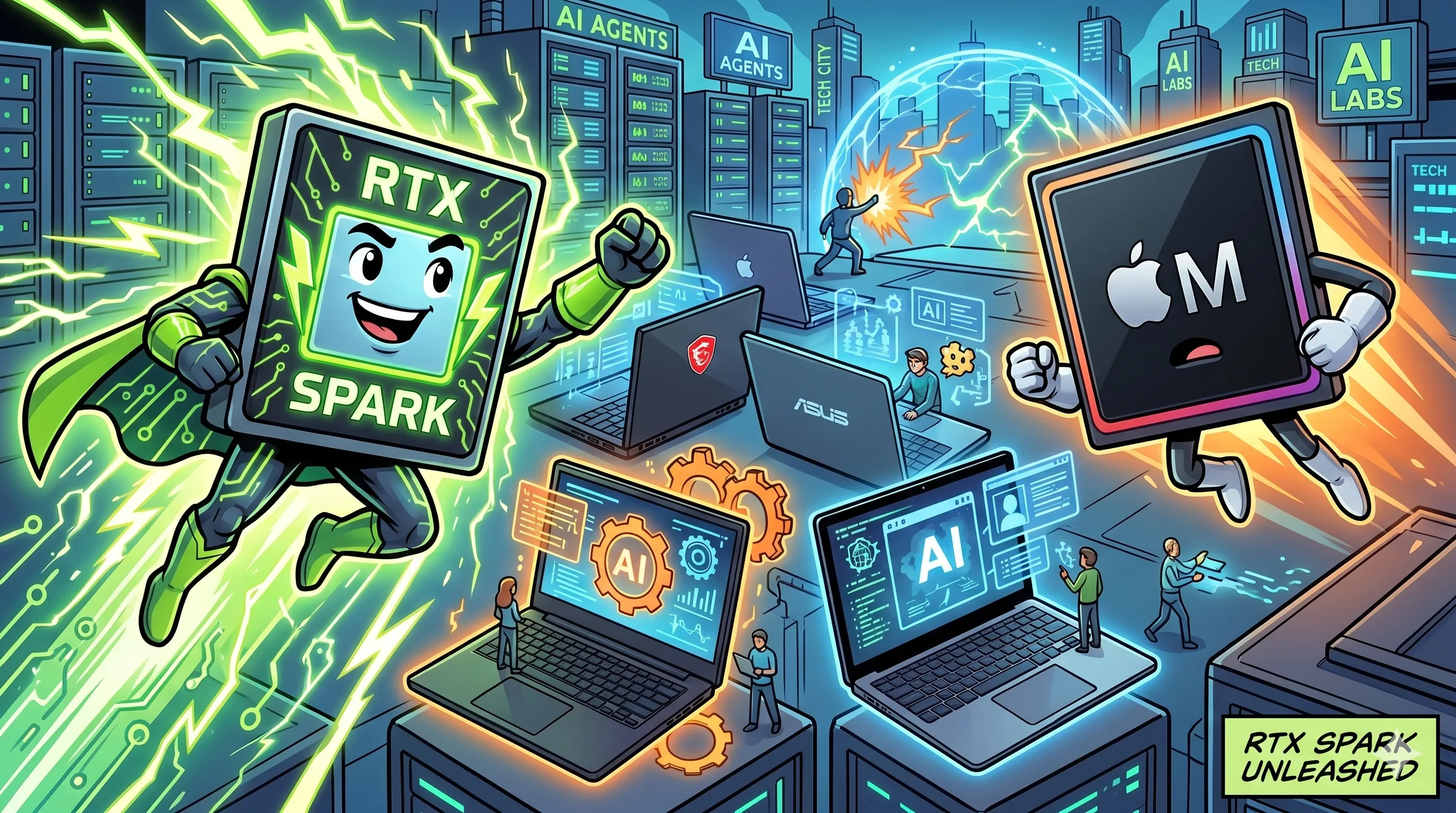
For the last four decades, the dynamic between human and computer hasn’t changed much: you click, you type, and the machine waits. At Computex 2026, NVIDIA CEO Jensen Huang declared that this era is officially over.
Enter the NVIDIA RTX Spark, an ambitious architectural leap designed to transition the personal computer from a basic tool into an autonomous “teammate.” Built to run advanced, local AI agents securely right on your device, this new system-on-a-chip (SoC) framework is rewriting the playbook for premium Windows laptops.
What is the NVIDIA RTX Spark?
The RTX Spark is a highly integrated “superchip” built on the Windows on ARM platform. Rather than pairing an Intel or AMD CPU with a separate, power-hungry dedicated graphics card, NVIDIA has combined everything onto a single, ultra-efficient silicon package.
Developed in a strategic partnership with MediaTek and fabricated using TSMC’s advanced process nodes, the RTX Spark architecture includes:
- The CPU: A custom, high-performance 20-core NVIDIA Grace CPU (optimized by MediaTek for extreme power efficiency).
- The GPU: A massive NVIDIA Blackwell RTX GPU packing 6,144 CUDA cores, bringing native desktop-grade graphics to slim form factors.
- AI Prowess: Fifth-generation Tensor Cores with FP4 precision pushing a staggering 1 Petaflop of AI compute.
- Unified Memory: Up to 128GB of high-speed unified memory, allowing both the CPU and GPU to pull from the same massive pool of VRAM.
Because the system is built to safely run local AI models (like OpenClaw or Hermes Agent), NVIDIA collaborated with Microsoft to create OpenShell—a native Windows security architecture that keeps personal agent data private on-device.
NVIDIA RTX Spark vs. Apple Silicon: Are They Similar?
At first glance, the comparison is obvious. The RTX Spark is the most direct challenger to Apple Silicon (specifically the M-Series Max and Ultra chips) that the Windows ecosystem has ever seen.
How They Are Similar:
- The ARM Architecture: Both chips ditch traditional x86 architecture in favor of ARM, yielding massive leaps in battery life and thermal efficiency.
- Unified Memory Structure: Just like Apple’s M-series, the RTX Spark shares up to 128GB of RAM dynamically between the CPU and GPU. This completely eliminates the bottleneck of copying data between system RAM and dedicated VRAM, enabling the laptop to run massive 120-billion-parameter local LLMs.
- True Single-Chip Efficiency: Both target slim laptop chassis (down to 14mm thick) while promising all-day battery life and quiet fans under load.
How They Drastically Differ:
- Graphics and Gaming DNA: Apple Silicon includes excellent integrated graphics, but it lacks the 30 years of specialized gaming architecture NVIDIA commands. The RTX Spark brings full, native support for NVIDIA CUDA, Ray Tracing, DLSS, Frame Generation, and Reflex. It can run AAA games at 1440p at over 100 FPS flawlessly—an area where Mac gaming still stumbles.
- Raw AI Compute Power: While Apple’s Neural Engine is incredibly efficient for day-to-day machine learning, the RTX Spark’s Blackwell Tensor Cores operate at a completely different tier, aiming at full-scale agentic AI processing with its 1 Petaflop ceiling.
- The Software Ecosystem: Apple Silicon operates tightly inside macOS. The RTX Spark is explicitly built to power a new generation of Windows on ARM PCs, working closely with Microsoft’s Copilot+ ecosystem while establishing its own local middleware layer (OpenShell).
Where Does It Stand? The Competitive Tier
The RTX Spark isn’t trying to compete with entry-level budget Chromebooks or standard thin-and-lights. It sits comfortably at the top of the Premium, High-Performance Prosumer Tier.
If you are cross-shopping processors in this exact weight class, its direct rivals include:
- Apple M5 Pro / M5 Max: The gold standard for creator-focused unified memory chips, prioritizing seamless hardware-software integration on macOS.
- AMD Ryzen AI Max (Strix Halo): AMD’s high-end elite mobile processor, which similarly leverages a massive integrated GPU and wide memory bus to challenge discrete graphics cards.
- Qualcomm Snapdragon X Elite / Elite 2: Qualcomm’s flagship Windows on ARM chips. While Qualcomm focuses more heavily on everyday battery efficiency and lightweight productivity, the RTX Spark acts as the “muscle car” version of Windows on ARM.
The First Wave: Laptops Using NVIDIA RTX Spark
NVIDIA has confirmed that every major PC OEM is throwing its weight behind the platform. Laptops featuring the RTX Spark are slated to hit shelves in the Fall of 2026.
Expect premium builds featuring sleek aluminum chassis, high-refresh OLED displays, and G-SYNC compatibility. The initial flagship lineup includes:
- Microsoft Surface Laptop Ultra: Expected to be Microsoft’s ultimate flagship showcase for agentic AI and on-device Windows processing, configured with the top-tier 128GB unified memory spec.
- Dell XPS 16 (RTX Spark Edition): Dell is bringing the superchip to its iconic minimalist chassis, promising the rendering capability of an RTX 5070 laptop GPU but at a fraction of the power draw.
- ASUS ProArt & ROG Series: Tailored heavily for mobile creators editing 12K video and developers running intensive local AI pipelines.
- Lenovo, HP, and MSI Flagships: Sleek, 14-to-16-inch machines designed for elite business productivity, heavy programming, and on-the-go AAA gaming.
- (Models from Acer and GIGABYTE are confirmed to follow shortly after the initial wave.)
Final Verdict
The NVIDIA RTX Spark represents a massive pivot in personal computing. By combining MediaTek’s mastery of mobile efficiency with NVIDIA’s industry-dominating Blackwell architecture, it effectively bridges the gap between the flawless battery life of a MacBook and the uncompromising performance of a Windows gaming rig.
If the software compatibility for Windows on ARM holds its ground—especially with anti-cheat software finally rolling out for ARM gaming—the RTX Spark laptops this fall will likely be the most sought-after hardware of the year.