The Architects of the Global Web: Understanding Tier 1 ISPs in 2026
The internet is often visualized as a cloud, but in reality, it is a physical, highly stratified hierarchy of hardware and agreements. At the very peak of this structure are the Tier 1 Internet Service Providers (ISPs). These entities are the true "backbone" of the global internet, owning the massive fiber-optic arteries that connect continents and dictate the flow of the world’s data.
Author
Viruchith Ganesan
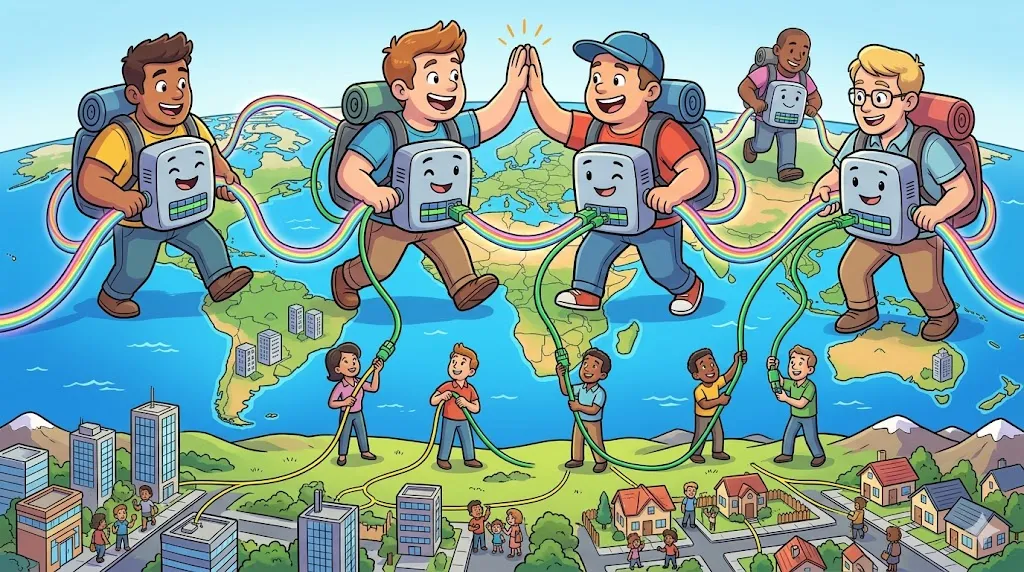
The internet is often visualized as a cloud, but in reality, it is a physical, highly stratified hierarchy of hardware and agreements. At the very peak of this structure are the Tier 1 Internet Service Providers (ISPs). These entities are the true “backbone” of the global internet, owning the massive fiber-optic arteries that connect continents and dictate the flow of the world’s data.
1. Defining the Hierarchy: The 3-Tier Model
To understand a Tier 1 ISP, one must look at how they relate to the rest of the network. The internet is categorized into three distinct tiers based on how they access the global routing table.
| Tier | Definition | Primary Relationship |
|---|---|---|
| Tier 1 | A network that can reach every other network on the internet without paying for transit. | Peer-to-peer (Settlement-free). |
| Tier 2 | Large regional providers that peer with some networks but must pay Tier 1s for global reach. | Hybrid (Peering + Paid Transit). |
| Tier 3 | Local “last-mile” providers (like home broadband) that pay for all their internet access. | Customer (Paid Transit only). |
2. The Golden Rule: Settlement-Free Peering
The defining characteristic of a Tier 1 ISP is Settlement-Free Peering.
In a standard business relationship, a customer pays a provider for a service. However, Tier 1 ISPs operate on a “handshake” logic. If AT&T (USA) and Orange (France) both own massive, global networks, it is mutually beneficial for them to exchange traffic directly. Since the volume of data they exchange is roughly equal and their infrastructure is comparable, they agree to carry each other’s traffic for free.
Note: This is an exclusive “club.” To become a Tier 1, a network must be so large that existing Tier 1s need access to its customers. If a network is too small, the giants will simply charge them for “IP Transit” instead of peering.
3. The Business Model: How the Giants Profit
If Tier 1s aren’t paying for their own internet access, how do they generate revenue? Their business model is built on three pillars:
- Selling IP Transit: They charge Tier 2 and Tier 3 ISPs for access to the global backbone. This is essentially selling “the bridge” to the rest of the world.
- Enterprise Managed Services: They provide high-bandwidth, dedicated circuits, and Global WAN (Wide Area Network) services to multinational corporations that require 99.999% uptime.
- Infrastructure Leasing: They own the subsea cables. Other companies (including tech giants like Google or Meta) often lease “dark fiber” or specific wavelengths on these cables.
4. Why Tier 1 Status Matters
For the average user, the existence of Tier 1 ISPs is invisible, but for global stability and performance, they are critical:
- Lower Latency: Data traveling through a Tier 1 network stays on a high-speed backbone longer, avoiding the “hops” through smaller, slower networks that cause lag.
- Global Resilience: They manage the physical redundancy of the internet. If a subsea cable is cut in the Atlantic, a Tier 1 provider can instantly reroute traffic through the Pacific or across land-based terrestrial fiber.
- Data Sovereignty: Nations often view their domestic Tier 1 providers (like Tata Communications in India or Deutsche Telekom in Germany) as strategic assets for national security and digital independence.
5. The Top 10 Global Tier 1 ISPs (2026 Rankings)
While the “Tier 1” list is not an official government registry, the following ten companies are universally recognized as the anchors of the global routing table in 2026:
- Arelion (formerly Telia): Headquartered in Sweden, Arelion consistently holds the #1 spot for the most connected backbone in the world.
- Lumen (formerly CenturyLink): The dominant force in North American fiber, with an massive footprint in enterprise and government sectors.
- NTT Communications: A Japanese giant that serves as the primary gateway for traffic moving between Asia, Oceania, and the Americas.
- Tata Communications: Based in India, they own the world’s largest wholly-owned subsea fiber network, circling the entire globe.
- GTT Communications: A “cloud networking” specialist that has built a massive Tier 1 status through strategic infrastructure acquisitions.
- Orange (OpenTransit): The backbone of Europe and Africa, providing the critical link for much of the southern hemisphere’s connectivity.
- AT&T: One of the oldest and most established Tier 1s, with deep-rooted infrastructure across the United States.
- Verizon: Known for its high-performance global network and focus on secure, low-latency enterprise traffic.
- Deutsche Telekom: The central “hub” of the European internet, managing the majority of traffic flow through Germany and its neighbors.
- Zayo Group: A major provider of bandwidth-heavy infrastructure, focusing on connecting data centers and large-scale cloud environments.
6. The 2026 Landscape: The Rise of “Tier 0”?
As we move through 2026, the traditional hierarchy is shifting. Hyper-scalers like Google, Meta, and Amazon now own more subsea cable capacity than many traditional Tier 1 ISPs. While they aren’t technically “ISPs” because they don’t sell transit to the public, they have created a “Shadow Backbone.”
This shift towards Private Network Interconnects (PNIs) means that more traffic is moving off the “public internet” and onto private, AI-managed fiber lines to support the massive data demands of generative AI and real-time edge computing.